Our STORY
Humphrey Errington began making cheese at Walston Braehead Farm in the early 1980s with a small flock of ewes. His first creation, Lanark Blue, quickly grew in popularity and remains a defining part of our range today.
In 2008, Selina introduced Corra Linn, making use of the natural glut of spring milk. When Humphrey retired around 2010, the business remained a family affair, run by Andrew and Selina. In 2019, Andrew brought dairy goats to the farm, allowing us to produce cheese year-round without relying on bought-in cow’s milk.
All the milk we produce on the farm is made into cheese by hand by our small team of dedicated cheesemakers, led by Angela (Andrew’s sister). Each morning, fresh milk is pumped directly from the parlour into our traditional cheese rooms, ensuring every batch starts with the best possible raw ingredients.
Because we only use our own milk, our cheeses reflect the seasons, the land, and the natural variations in milk throughout the year—so there may be times when some varieties aren’t available.
To maintain the highest standards, we send our milk and cheese for weekly microbiological testing at an independent laboratory and have introduced daily in-house milk testing. Alongside statutory environmental health audits, we also undergo a SALSA + Cheese audit annually, following the Specialist Cheesemakers Association Code of Practice, which we have signed up for as members.
SHOP OUR CHEESE
Description:
Corra Linn is a raw milk, cloth-bound cheddar-style cheese made from the milk of our ewes. The cheese has a firm, crumbly texture and a smooth, sweet, tangy flavour. The cloth-bound process gives Corra Linn its distinctive rind and imparts a natural, earthy flavour. The cheese matures over several months, developing adeep, nutty character with grassy notesthat reflect the environment in which the ewes are raised.
Corra Linn is named after a waterfall at New Lanark.
How it’s made:
Corra Linn is made using raw milk from our ewes, preserving all the natural flavours of the milk. The process begins by heating the milk and adding cultures, then the rennet to form the curds. After the curds are cut and scalded, the whey is drained and blocks of curd are piled high until the required acidity is reached. The curds are then milled and salted before being pressed into the cloth-lined moulds where they are pressed overnight. The following day they are wrapped in muslin cloth and placed on wooden shelves in the cheese store. This cloth maturation process allows the cheese to develop a natural rind, while the internal texture becomes firm and slightly crumbly. The cheese is aged in a cool, humid environment, allowing it to mature slowly, drawing out its nutty, sharp flavours. Corra Linn is made in small batches, ensuring that each wheel reflects the quality of the land and the ewes that produce the milk.
CORRA LINN was awarded ‘Super Gold’ at the 2025/26 World Cheese Awards.
Tasting notes:
Texture: firm, crumbly
Palate: nutty, subtle sweetness, grass, earthy
Pairings + Accompaniments
Food: quince paste, proscuitto, olives, crackers or crusty bread, beetroot jam
Wine:
Sangiovese Chianti - the earthy flavour and tannins from the wine cling to the protein in the cheese enhancing the sour-cherry fruit flavour of the wine and richness of the cheese.
Monstable Chardonnay – the high acidity of the wine cuts through the fatiness of the cheese cleansing the palate.
Beer: IPA (Merlin’s or Stewarts IPA)
Please email for alternative sizes or requirements and we will email you payment link to order hello@erringtonsbarn.co.uk
Description:
Elrick Log is a fresh, soft, lactic-style goat’s cheese, rubbed in vegetable ash. The cheese has a smooth, creamy texture with a light, tangy flavour that is subtle yet refreshing. The ash rub not only adds visual appeal but also imparts a light smokiness, enhancing the cheese’s earthy, herbal qualities. It is a cheese that embodies the simplicity and beauty of fresh goat’s milk, with a distinct layer of complexity from the ash.
Elrick Log is the historic name for the town of Elsrickle close to the farm where the cheese is made.
Each individually-wrapped Elrick Log weighs a minimum of 190g.
How it’s made:
Elrick Log is made with fresh, raw goat's milk which is gently heated to room temperature and cultures are added. Once the correct acidity is reached a tiny amount of rennet is added and the milk gently sets overnight before being hand-ladled into the forms where the whey drains out. The cheese is then formed into small logs, and once de-moulded it goes in the hastener to allow the yeast rind to start growing. The cheese is then sprinkled with salt which is mixed with ash to flavour and protect the cheese and add a rustic, smokey touch. The ash also helps to form a natural rind as the cheese matures. They’re typically consumed young, retaining its fresh, tangy flavours and smooth texture. As the cheese ripens the rind will break down and become runny. The cheese forms a natural rind (we don’t add a white bloomy rind), however sometimes natural moulds can appear on the surface which are entirely normal and enhance the flavours.
Elrick Log was awarded ‘Silver’ at the 2025/26 World Cheese Awards.
Tasting Notes:
Texture: soft, fudgy, marshmallow goo-iness
Palate: complex, subtle smokiness, umami, earthy mushroom, fresh and citrus when young, spicy as it ages
Pairings + Accompaniments
Food: Scottish honey, sweet fruits, strawberries, walnuts, citrus marmalade
Wine: Champagne, Chenin Blanc, Chardonnay
Please email for alternative sizes or requirements and we will email you payment link to order hello@erringtonsbarn.co.uk
Description:
Blackmount is a fresh, soft, lactic-style goat’s cheese, rubbed in vegetable ash. The cheese has a smooth, creamy texture with a light, tangy flavour that is subtle yet refreshing. The ash rub not only adds visual appeal but also imparts a light smokiness, enhancing the cheese’s earthy, herbal qualities. It is a cheese that embodies the simplicity and beauty of fresh goat’s milk, with a distinct layer of complexity from the ash.
Blackmount if named after the South outlier hill to the north of the barn, and south of the farm.
Each individually-wrapped Blackmount weighs a minimum of 220g.
How it’s made:
Blackmount is made with fresh, raw goat's milk which is gently heated to room temperature and cultures are added. Once the correct acidity is reached a tiny amount of rennet is added and the milk gently sets overnight before being hand-ladled into the forms where the whey drains out. The cheese is then formed into mounds, and once de-moulded it goes in the hastener to allow the yeast rind to start growing. The cheese is then sprinkled with salt which is mixed with ash to flavour and protect the cheese and add a rustic, smokey touch. The ash also helps to form a natural rind as the cheese matures. They’re typically consumed young, retaining its fresh, tangy flavours and smooth texture. As the cheese ripens the rind will break down and become runny. The cheese forms a natural rind (we don’t add a white bloomy rind), however sometimes natural moulds can appear on the surface which are entirely normal and enhance the flavours.
Tasting Notes:
Texture: soft, fudgy, marshmallow goo-iness
Palate: complex, subtle smokiness, umami, earthy mushroom, fresh and citrus when young, spicy as it ages
Pairings + Accompaniments
Food: Scottish honey, sweet fruits, strawberries, walnuts, citrus marmalade
Wine: Champagne, Chenin Blanc, Chardonnay
Please email for alternative sizes or requirements and we will email you payment link to order hello@erringtonsbarn.co.uk
Description:
Bonnington Linn is a hard, cheddar-style cheese made from the milk of our goats. This cheese is firm and has a slightly granular texture, with a rich, nutty flavour and a mild tanginess. The flavour profile develops as it matures, becoming more pronounced with age, showcasing the earthy and slightly sweet qualities of the goat's milk. Bonnington Linn is ideal for those who enjoy the deep, full-bodied flavours of cheddar-style cheeses with a distinctively goat’s milk character.
Bonnington Linn is one of the waterfalls at New Lanark’s Falls of Clyde.
How it’s made:
Bonnington Linn is crafted from high-quality raw goat’s milk produced on our farm. The milk is warmed in the vat and the cultures are added, once acidity has started rennet is added and the milk is allowed to set to form curds. The curds are cut, stirred and scalded before the whey is drained. They form blocks which are stacked, then milled and salted. The cheese is then placed in moulds and pressed overnight. The following day the cheeses are wrapped in traditional muslin cheese cloth before being aged for several months. The ageing process allows the flavours to deepen and develop a more complex, nutty profile, while the texture becomes firmer and slightly crumbly. Throughout the entire process, we ensure that only the best methods and sustainable practices are used to produce a cheese that showcases the unique character of the milk and the care with which it’s made.
Tasting Notes
Texture: firm, slightly granular
Palate: rich, nutty, mild tanginess, distinctive herbal characteristics
Pairings + Accompaniments:
Food: fresh fig or apricots, roasted nuts, cold cut meats, rye crackers
Wine: Sauvignon Blanc or Pinot Noir - acidity of wine cleanses palate
Beer: Stewart’s Lager - crisp freshness of lager adds a refreshing contrast
Please email for alternative sizes or requirements and we will email you payment link to order hello@erringtonsbarn.co.uk
Seasonal Errington Cheese Selection
A carefully chosen selection of four farmhouse cheeses, chosen to reflect the best of the season. Each box showcases a mix of our ewe and goat’s milk cheeses, made on the farm and naturally reflecting the time of year.
As our cheeses follow the rhythm of the land, the selection changes with the seasons, meaning no two boxes are quite the same.
Sending as a gift?
We can pop a personal giftcard with your cheese into the box. Please enter your message on the checkout page.
CHEESEMAKING PROCESS
-
1. WARM MILK AND ADD STARTERS
The ewe's or goat’s milk is pumped directly from the bulk tank into the vats and the starters are added as the milk slowly warms. The milk is then left for around an hour and gently stirred at intervals by hand.
-
2. ADD RENNET & ALLOW TO SET
After the milk has been warmed and been given time with the starters the rennet is added. We mix this with our own farm spring-water and add to the milk stirring very briefly. The ewes milk only takes a short time to set.
-
3. CUT CURD
Once the milk has set it is checked and then cut with stainless steel knives vertically then horizontally to form small cubes. We then leave the curd for a little to allow it to heal.
-
4. STIR
Once the curds have healed they are then stirred very gently. This heals the curd further. When we are making Corra Linn we turn the vat back on and scald the curd, stirring continuously. This takes more of the moisture out of the curd.
We then pull the curds back and allow them to settle. This helps pitching and minimises the amount of curds draining away with whey.
-
5. DRAIN OFF THE WHEY
The whey is drained off slowly after the curds have settled. We then slowly form a channel in the centre of the curd which eventually allows all the whey to be drained, leaving curd up each side of the vats.
-
6. FILL THE MOULDS
Once the whey has drained off the curd we fill the moulds with the curds and move through to another warm room.
When we are making Corra Linn we cut the curds into blocks and turn every half hour or so as the acidity rises. Once the acidity is where we want it, we then mill the curd into the vat and salt the curd. The curd is then placed in moulds, lined with cheesecloth and put into the press.
-
7. TURNING
We turn the lactic cheese five times throughout the afternoon. This assists with drainage of the whey and helps the cheese to form a uniform shape. We check the titratable acidity during this process to ensure that it is rising. The following morning the cheese is turned once more and moved to a cooler room.
When making Corra Linn we take the cheeses out of the moulds, trim and rub a local rapeseed oil on the surface of the cheese, then re-cloth in traditional muslin cheesecloth and turn and re-press until the following morning.
-
8. SALTING
We dry salt our cheese by hand during the afternoon and place onto racks.
The Corra Linn is put into a separate maturing room on wooden racks after the cheese has been taken out of the press.
-
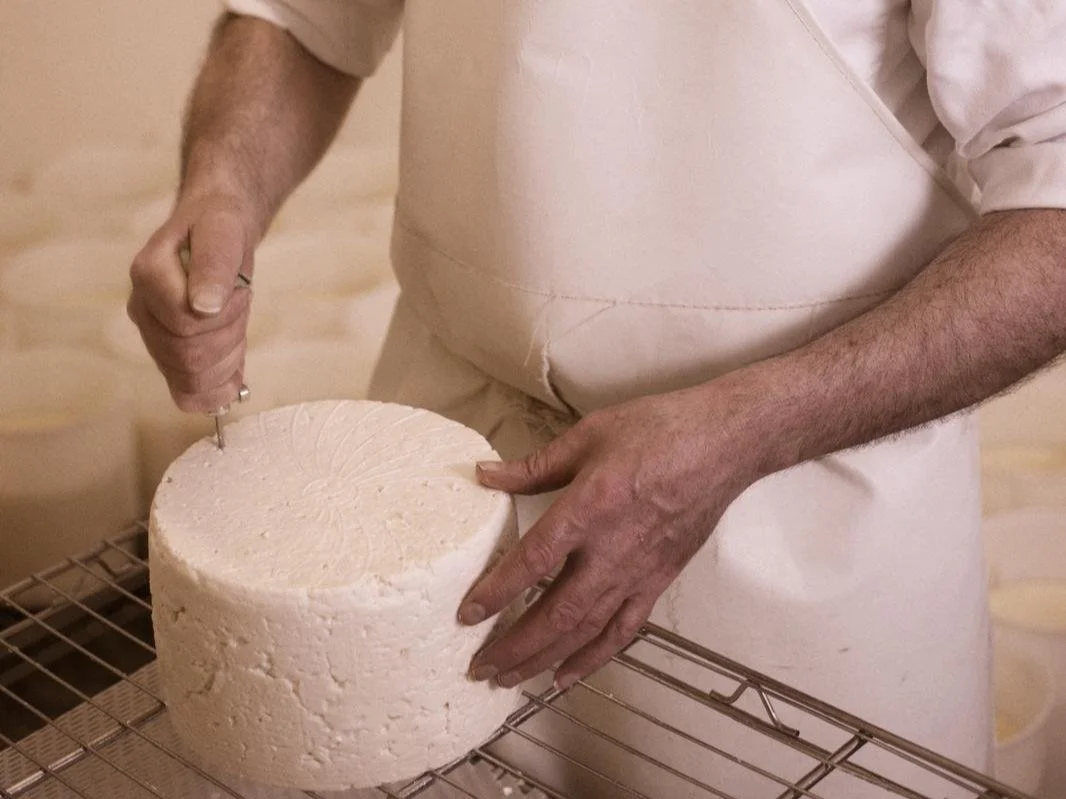
9. PIERCING
For blue cheese, piercing follows the salting and is presently done by hand using stainless steel skewers which we had purpose made. The cheese is turned again and put back on stainless steel racks in our maturing room.
Piercing allows more air to reach the blue cultures in the cheese, which is essential for these cultures to flourish and grow.
-
10. MATURING
Our traditional farm buildings make perfect cheese making maturation rooms. Due to their thick stone walls they help keep a high level of humidity which is essential for our cheeses.
The hard cheeses are turned twice a week by hand until they are ready for sale or alternatively our blue cheese is wrapped in foil and moved to a lower temperature room to continue its maturation.
The Corra Linn is rubbed down once a week and turned to ensure even maturation until it is ready for sale.
Description:
Lanark Blue is a distinctive blue cheese made from the milk of our Lacaune ewes. It is a semi-soft cheese with a beautiful, creamy texture and characteristic blue veins that provide an earthy, tangy flavour. The cheese has a natural richness from the ewes' milk, with an added complexity from the blue mould, which develops as the cheese ages. The flavour is bold, yet smooth, with a slight sweetness that balances the sharp tang of the blue.
How it’s made:
Lanark Blue is made by hand using traditional farmhouse cheesemaking methods. The milk is sourced exclusively from our own flock of ewes, which graze on lush, seasonal grass. The milk is gently heated, and a blue mould culture introduced. Vegetarian Rennet is added to set the milk, after the curds form, they are cut and stirred to release the whey. The cheese is then placed in moulds, salted, and aged for several weeks to develop its unique flavour and texture. During the ageing process, the cheese is pierced to allow the blue mould to grow, creating the characteristic blue veining.
Tasting notes:
Texture: Semi-soft, creamy
Palate: earthy, tangy, salty, ripe in winter / fresh in summer, bold, natural sweetness
Pairings+ Accompaniments
Food: honey or fig jam, fresh bread, smoked meats, ginger bread
Beer: Old Jock (Broughton Ales) or Edinburgh Black (Stewart Brewing)
Port or Scotch Whisky: The smooth texture of port complements the strong rich flavours of the cheeses and enhances its more subtle earthy notes.
Please email for alternative sizes or requirements and we will email you payment link to order hello@erringtonsbarn.co.uk